
It is not a lighter Overseer syllabus
സർവേയർ പരീക്ഷ വേറെയാണ്. എളുപ്പമല്ല — വ്യത്യസ്തമാണ്.
The most common mistake at this level is treating Surveyor as the Overseer syllabus with the hard parts removed. It is not. It is a narrower syllabus studied to greater depth, weighted heavily towards instruments, field procedure and calculation.
Which means a broad, thin study approach that would scrape a pass elsewhere performs badly here. There are fewer places to hide when the syllabus is small — the examiner has to go deeper to fill a paper.
What the paper actually leans on
- Instruments, in detail. Not what a theodolite is — which adjustment, in what order, and what the error looks like when it is wrong.
- Field procedure. The sequence of a traverse, the checks, what you do when a check fails.
- Numerical work, constantly. Bearings, corrections, areas, volumes, levelling reductions. This is the biggest single difference from the other levels.
- The confusable instrument pairs. Which instrument establishes a grade contour, which one is for hill roads — questions built on two instruments that do adjacent jobs.
That last category is where papers are decided, and it is pure discrimination — exactly the skill that only comes from meeting the same pair from both directions, repeatedly.
Numericals are not a section — they are the texture
At other levels you can decide numericals are not your strength, lose those marks and still pass on breadth. At this level that strategy does not survive contact with the paper.
The practical consequence for your plan: do calculation every single study day, in small amounts. Not a numericals week. Numerical fluency behaves like a physical skill — it decays quickly and rebuilds slowly, so twenty minutes daily beats a five-hour Sunday.
Where Tracer fits — and it is not here
ട്രേസർ തസ്തിക സർവേയർ ട്രാക്കിലല്ല.
People pair these two constantly, so it is worth stating plainly: on our course mapping, Tracer sits with the ITI Level track, not with Surveyor. The Surveyor track covers Surveyor Gr.II, Tradesman (Survey) and Survey & Land Records.
That is not an arbitrary filing decision. The work is different. Tracer leans towards drawing, tracing and reproduction — the drawing-office side of the discipline. Surveyor leans towards the field: instruments, observation, correction, computation.
They share vocabulary, which is exactly why the confusion persists and why it is expensive. If you are preparing for Tracer using a Surveyor-weighted plan, you are over-investing in instrument adjustment and under-investing in the drawing work that will actually be tested.
Check the notification for the post you are sitting and let that decide the track — not the fact that both words appear in the same sentence on somebody's advertisement.
The instrument pairs worth drilling
Since discrimination decides this paper, here is the shape of what to drill. Not a complete list — a demonstration of the kind of pair that keeps appearing:
- Instruments that both establish a gradient, where one is keyed for ordinary grade contour work and the other only for hill and ghat road stems.
- Chain-survey against compass-survey corrections — which correction belongs to which, and what each is compensating for.
- Temporary against permanent adjustment for the same instrument. Papers ask which category a named step falls into far more often than they ask how to do it.
- Plane table methods — radiation, intersection, traversing, resection — distinguished by what you know before you start rather than by procedure.
Study each of those as a pair, in one sitting, with the difference written out in your own words. Studied separately, weeks apart, they will merge under exam pressure — which is precisely what the question is designed to exploit.
Four ways the Surveyor course genuinely differs
ഇത് പരസ്യമല്ല — വ്യത്യാസങ്ങൾ തുറന്നു പറയുന്നു.
This is the section a sales page would leave out. The Surveyor track is built differently from our other levels, and if you are comparing them you should know exactly how before you decide.
- It does not stack. The Diploma membership includes the ITI level, and the B.Tech membership includes both. Surveyor does not work that way — it is its own track, 5 courses and 227 chapters, and it does not carry the other levels with it.
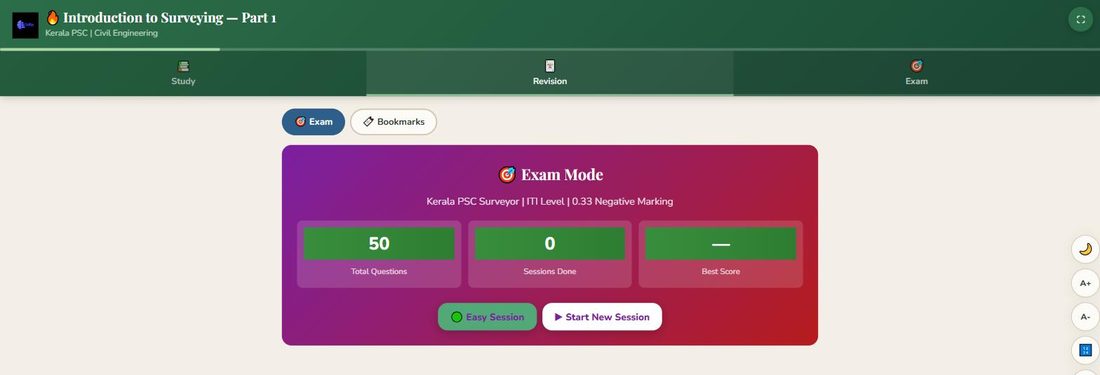
- There are no cumulative module exams on this track. The other levels have them; Surveyor has quizzes and exam mode, but not the cumulative exams. If that feature is what you are buying for, buy the level that has it.
- Smart Interactive Lessons cover part of the track, not all of it — 123 of the 227 chapters. The rest are taught by video and quiz. That is real coverage and it is not total coverage, and the difference matters when you are comparing against a page that implies everything everywhere.
- It is smaller, and that is appropriate. 227 chapters against 514 at ITI level. The syllabus is genuinely narrower; the course is not thin, it is scoped.
I would rather you knew these four things now than discovered the second one in month three. If they change what you want to buy, they have done their job.
How to actually study this level
| Do | Instead of |
|---|---|
| Twenty minutes of calculation every study day | A numericals block once a fortnight |
| Learning instruments in confusable pairs | Learning instruments one at a time, alphabetically |
| Past papers early — this syllabus repeats heavily | Saving the papers for the last month |
| Working the field-procedure sequences until the order is automatic | Memorising the definition of each step separately |
The third row deserves emphasis. A narrow syllabus repeats more than a broad one, simply because there is less to ask about. Past papers are therefore worth more at this level than at any other — start them early.