
The mistake is not switching. It is restarting
പഠിച്ചത് നഷ്ടപ്പെടുത്തരുത്. ആദ്യം മുതൽ തുടങ്ങേണ്ട.
People who move mid-preparation almost always do the same thing: they open the new course at chapter one and begin again.
It feels responsible. It is the single most expensive decision available to you. Eight months of classes left you with real coverage — unmeasured, uneven and partly forgotten, but real — and starting again spends your remaining time re-acquiring things you already have.
You are not starting a preparation. You are continuing one that nobody has measured yet.Santhosh Sir
Week one: find out what you actually have
Before studying anything new, spend the first week establishing where you stand. Not by reading — by being tested.
- Take a quiz on every subject you believe you have covered, without revising first. Revising first defeats the entire purpose.
- Write down the score per subject. This list is the most valuable document in your preparation and it takes a week to produce.
- Sit one full past paper under a clock with negative marking applied.
The results will sort your covered subjects into three groups, and they need three different treatments:
| What the score says | What it means | What to do |
|---|---|---|
| Strong | The classes worked and it stuck | Do not restudy. Schedule spaced revision and leave it alone. |
| Middling | You met it but it did not consolidate | Questions and explanations, not re-watching. This is where the fastest gains are. |
| Weak | Covered in name only | Treat as new material. Full study. |
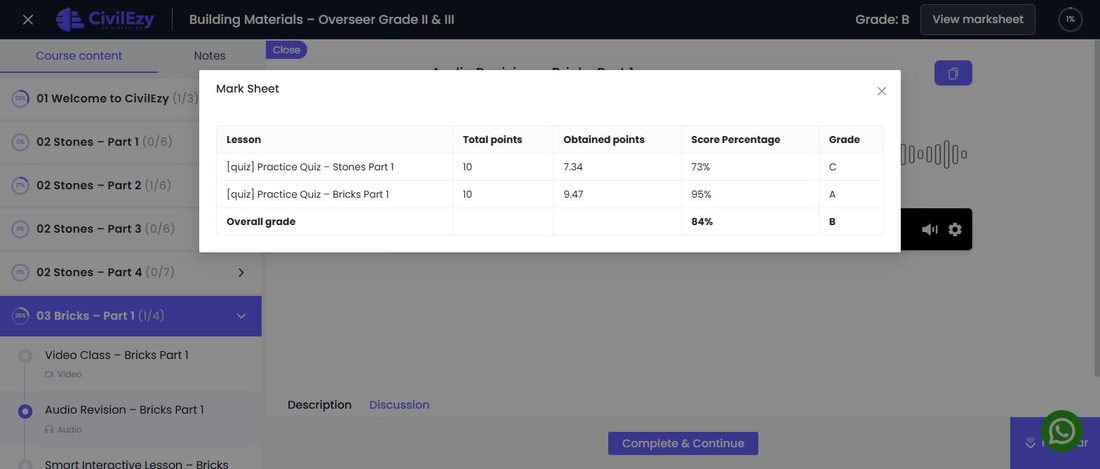
Most people are surprised by the middling group. It is usually the largest, and it is where the cheapest marks in your entire preparation are sitting — material you have already paid the learning cost for once, that simply never got consolidated.
Do not leave the class immediately
This will sound strange coming from us, so let me be plain about it: if your batch is mid-way through a subject, finish that subject before you leave.
Two reasons. Continuity in a subject is worth real marks, and a partly taught subject is the most likely thing to fall through the gap during a transition. And running both for two or three weeks tells you something a brochure cannot — whether the new arrangement actually fits your week.
A switch made in the middle of a subject, in a rush, is how people lose the one topic nobody covered twice.
What to keep from the traditional class
Not everything about the batch was wrong, and pretending otherwise leads people to discard things that were working:
- Your notes. They are in your handwriting, which makes them better revision material for you than anything printed.
- The fixed hour. If seven o'clock was when studying happened, keep seven o'clock. Move the content, not the habit — habits are far harder to rebuild than schedules.
- The people. A study group that pushes you is not a feature of the institute, it is a feature of the people. Keep it.
- The teacher, if the teacher was good. Nothing stops you attending a free live class while studying somewhere else. We run one nightly.
The first thirty days after switching
| Days | Focus | Why |
|---|---|---|
| 1–7 | Measure everything. Study nothing new. | Every later decision depends on this list existing. |
| 8–20 | Work the middling group hard | Cheapest marks available. Questions and explanations, not re-watching. |
| 21–30 | Weak subjects as new material; strong ones on spaced revision | Now you are studying to a plan instead of to a syllabus order. |
Notice there is no chapter one anywhere in that table.
What if you are switching very late?
If the exam is under sixty days away, the plan above is too leisurely and you should compress it hard rather than follow it politely.
- Measure in two days, not seven. Quizzes on your three heaviest subjects only. You do not have a week to spend on diagnosis.
- Work only the middling group. Weak subjects are, honestly, a next-cycle problem at this range — the return on starting a weak subject with six weeks left is poor compared with consolidating three shaky ones.
- Do not restudy strong subjects at all. Spaced revision only.
- Papers twice a week from day one, not from the last fortnight.
That is a triage plan and it should feel like one. Attempting a full syllabus in six weeks is the same mistake as restarting at chapter one, wearing a different disguise.
The other switch: right institute, wrong exam
Occasionally the problem is not where someone is studying — it is what they are studying for. Someone with a diploma prepares at ITI level because that is where their friends are, or an ITI holder works through AE material because it seemed more ambitious.
A very good system will prepare you efficiently for the wrong exam. That is worth checking before anything else, and it takes ten minutes: read the notification for the post you actually intend to sit, check the qualification, and compare its syllabus against what you have been studying.
If those two do not match, no amount of switching platforms fixes it — and if they do match, you can stop wondering.
How to tell whether the switch worked
Not by how it feels — a new platform always feels productive for a fortnight. Two honest checks at the six-week mark:
- Has the middling group moved? Those subjects should have measurably improved. If they have not, you are consuming content rather than practising.
- Can you name your three weakest chapters without thinking? If yes, the system is doing its job. If you are still answering that question with a feeling, nothing has actually changed except the logo.
That second check is the real test of any switch, ours included. The point was never a different set of videos. It was knowing where you stand while there is still time to act on it.