
Start with what a traditional class gets right
പരമ്പരാഗത ക്ലാസ് ശരിയായി ചെയ്യുന്നത് എന്താണ്?
Every year I meet students who have sat in a classroom for eight months, taken careful notes, understood every session — and still not cleared the exam. It would be easy to tell them the classroom was the problem. It was not. Our courses exist because of what I learned watching those students, not because I think classrooms are obsolete.
So let me argue the other side first. A traditional class gives you four things, and every one of them is real:
- A fixed hour when studying definitely happens.
- A teacher who notices whether you turned up.
- Other people in the room, visibly doing the same work.
- Somebody else deciding what today's topic is.
Now read that list again. Not one of those four is teaching. They are all structure. Discipline, attendance, peer pressure, and someone else carrying the burden of deciding what to do next.
That is not a criticism. It is the most useful thing anyone can understand about their own preparation.
What you are actually paying for is structure
This matters because it decides what a real alternative has to be. If a class were mainly selling information, free video would have replaced it a decade ago. It did not, and everybody quietly knows why: a folder of videos does not make anyone study.
A class was never really selling information. It was selling the scaffolding that makes you study at all. Which leads to the only question worth asking — does that scaffolding go far enough?
For a small number of students, it does. They go home, revise the same evening, keep a mistake notebook, test themselves cold, and find their own weak areas before the exam does. If that is you, honestly, you will pass from a traditional class and you do not need to read the rest of this.
For everybody else — and it is almost everybody — the class ends and the structure ends with it. The hour was excellent. The other twenty-three were left to willpower.
What "learning" means when the paper is 100 objective questions
പഠിച്ചു എന്നു തോന്നുന്നതും പഠിച്ചു എന്നതും ഒന്നല്ല.
Here is the single most expensive feeling in exam preparation: "I understood that class."
It feels like progress because it is genuinely pleasant. The teacher is clear, the logic follows, nothing is confusing. Your brain records that smoothness and files it as knowledge. Researchers call it the fluency illusion, and it is not a sign of a weak student — it is how everybody's mind works.
Understanding a topic while someone explains it, and retrieving it cold, from an unfamiliar question, in ninety seconds — these are two different skills. Only one of them is on the exam paper.Santhosh Sir
This is why the most sincere students are so often the most shocked by their result. They did not fail from laziness. They practised the wrong skill, very diligently, for eight months.
The three things the paper actually tests
- Recall — can you produce the value without the option list helping you?
- Discrimination — can you separate two answers that both look right? This is what assertion-reason and statement questions are built to attack.
- Speed — can you do the first two under a clock, with negative marking punishing the guess you would otherwise take.
None of the three improves by listening. All three improve by being tested, being wrong, and finding out immediately. That is the whole argument of this article, and everything below is just detail.
A class and a system, side by side
| What makes exam knowledge stick | A traditional class gives | A training system gives |
|---|---|---|
| Retrieval practice — recall beats re-reading | Almost none | Flashcards on every topic, and tens of thousands of practice questions |
| Spaced repetition | Whenever you happen to revise | A revision pass built into every topic |
| Immediate feedback | Next class, if you ask | An explanation on every single question |
| Exam-condition practice | An occasional model exam | Exam mode — timed, with negative marking |
| Finding your weak areas | Your own guess | A score per chapter, so the weak area names itself |
| Measurement | Results day | Every week |
| Coverage guarantee | Whatever the batch got through | Chapters mapped to the syllabus |
Look at the second-to-last row for a moment. Everything above it is about method. That one is about something else entirely, and it is the row that decides results.
What the system looks like on an ordinary Tuesday
The word "online course" makes people picture a folder of video files. That is fair, because that is what most of them are. So here is ours, on a normal evening, for one topic.
Every topic runs the same four-step loop, in the same order, every time — video class, audio revision, an interactive lesson, then a practice quiz. The grade sits in the corner of the screen while you work.
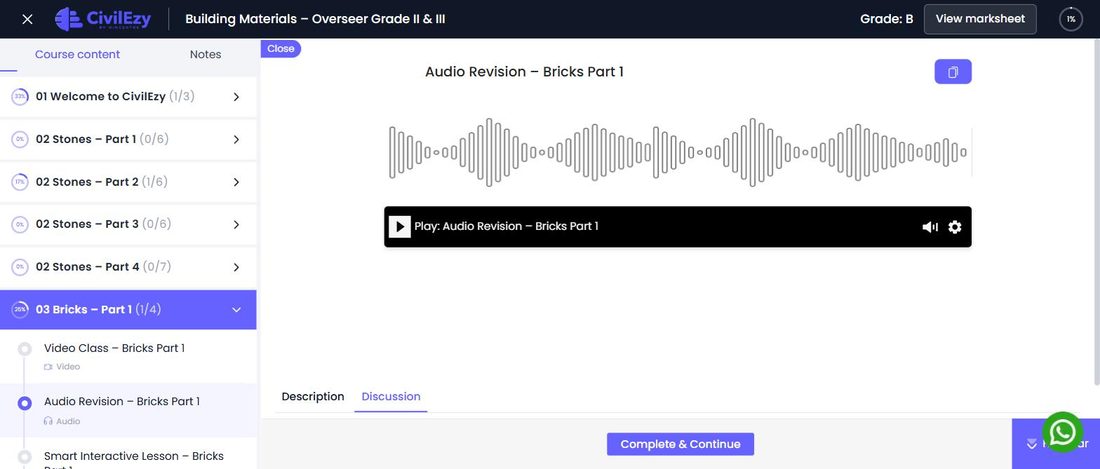
That fixed order is doing something specific. The video gives you input. The audio revision catches you again later the same day, on a bus or in a kitchen, which is spaced repetition whether you call it that or not. The interactive lesson makes you produce answers instead of nodding at them. The quiz tells you the truth.
Inside the interactive lesson there are flashcards for the topic, a mind map of the whole chapter, fill-in-the-blanks, numericals and assertion-reason practice — five different ways of being asked, because a fact you can only recognise in one phrasing is not a fact you own yet.
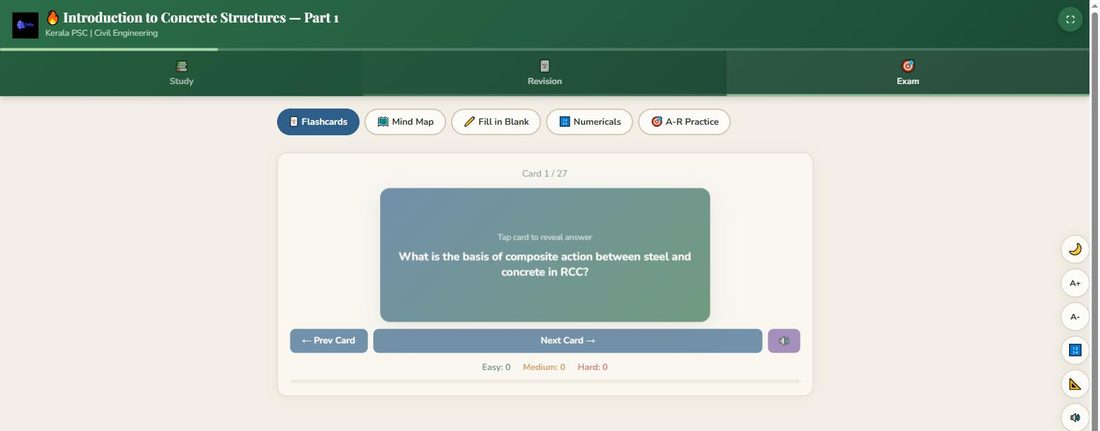
None of this is exotic. It is what a disciplined student would build for themselves if they had the time, the syllabus map and the question bank. The system's only real claim is that it removes the requirement to be that disciplined.
Where the practice volume comes from: the e-books
പഠിക്കാൻ കോഴ്സ്. ഉറപ്പിക്കാൻ ഇ-ബുക്ക്.
A four-step loop per topic is the right shape, but it is not enough volume on its own. Discrimination — telling two plausible answers apart — only comes from having been asked the same idea many different ways. That is what the e-books are for.
The word "e-book" is genuinely misleading here, and I have thought about changing it. These are not PDFs to read. Each one is a module split into chapters and topics, and every chapter carries its own bank of questions with a worked explanation on each, plus a cumulative exam once you finish the module.
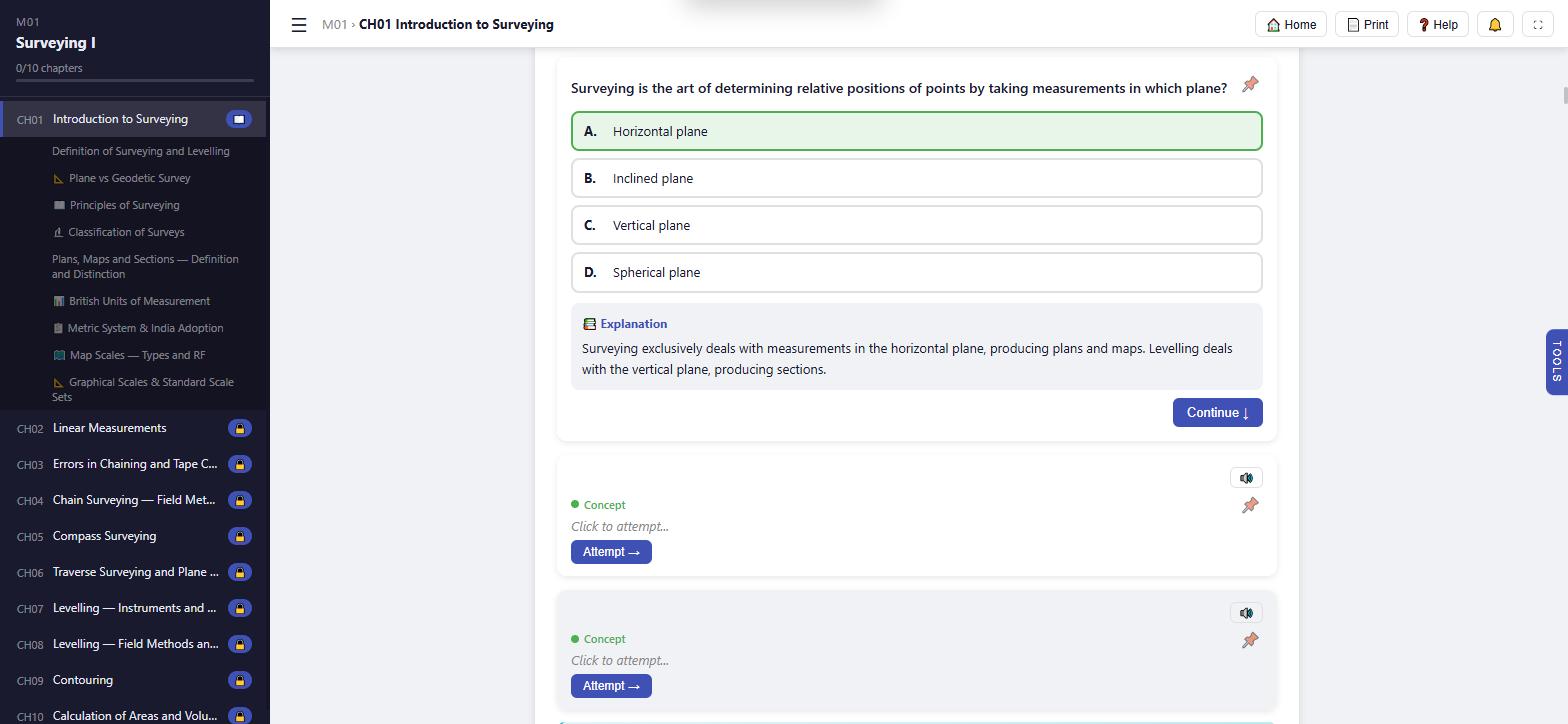
So the division of labour is simple. The course teaches the topic. The e-book is where it gets hard enough to stick. A student who finishes a chapter in the course and then works the matching e-book chapter has met that material as explanation, as recall, as a timed question and as a wrong answer they had to understand — four different encounters, which is roughly three more than a class can give.
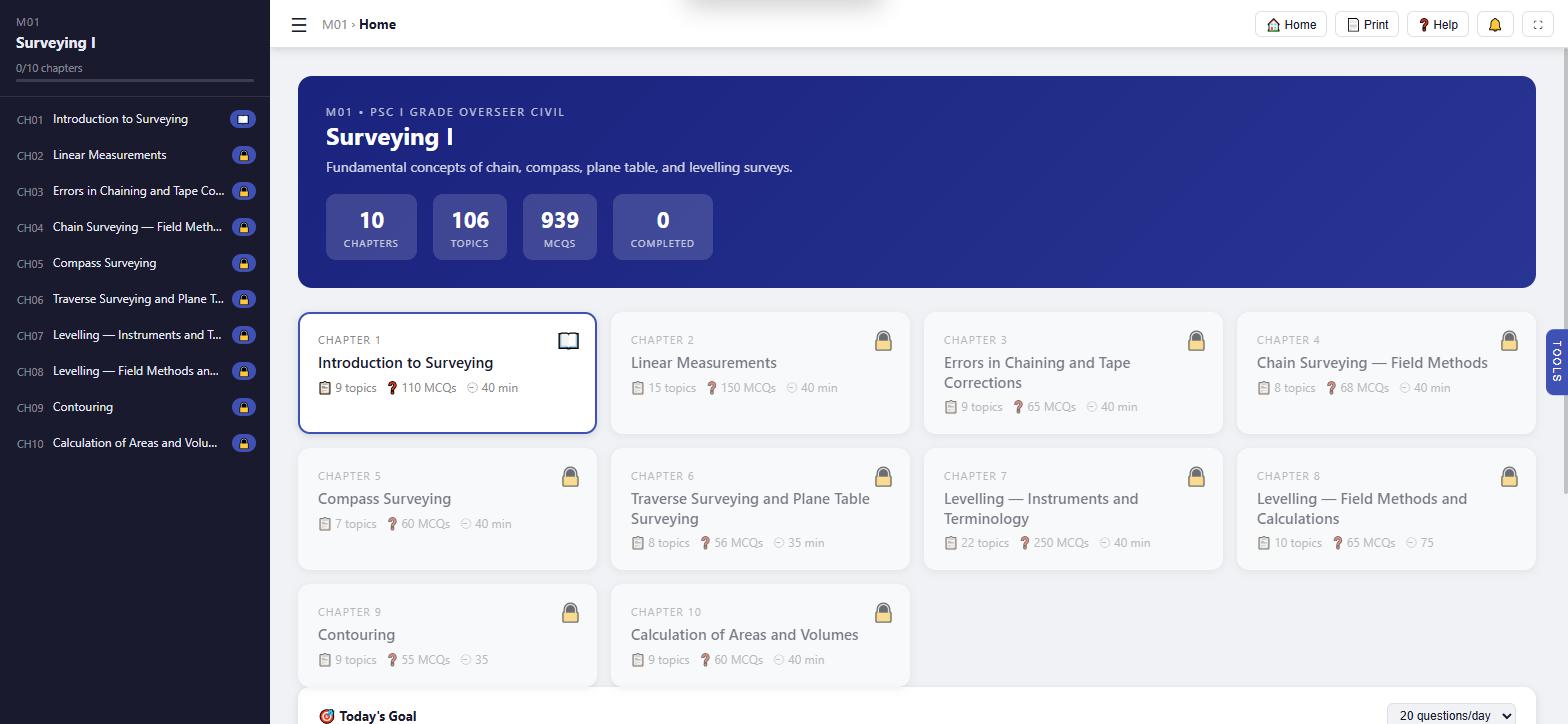
It also has a quieter advantage. Because the questions are written against the syllabus rather than against a textbook chapter, coverage stops being a matter of trust. You can see which chapters exist and which you have not touched.
The row that decides the result: measurement
എത്രത്തോളം തയ്യാറായി എന്ന് ഇന്നു തന്നെ അറിയാം.
Ask a student in a traditional class the simplest question — are you on track? — and the honest answer is that nobody knows. Not the student, and not the teacher. Attendance is known. Effort is visible. Readiness is a feeling. Everyone finds out together, on results day, when it is far too late to act on.
That is not anybody's fault. It is arithmetic. One teacher cannot mark fifty students on every chapter every week.
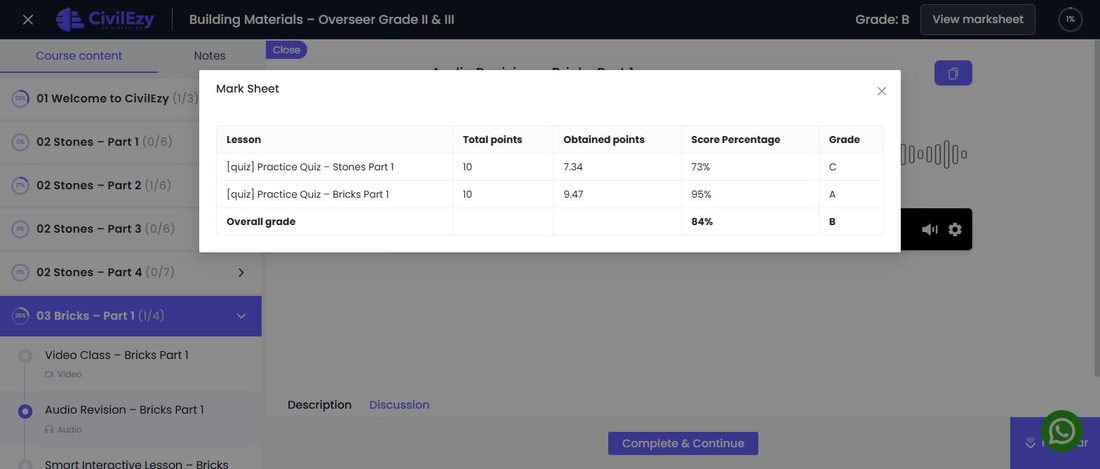
A system can, because measuring is the one thing software is genuinely better at than a human. Every quiz is scored the moment you finish it. Every chapter carries a grade. The overall grade moves as you work.
So the question stops being have I studied enough? and becomes which three chapters are below par, and what am I doing about them this week? That is a question you can actually act on — and it is available in month two instead of after the result.
But what about the teacher? We did not remove the class
This is the part people assume we are arguing against, so let me be plain: we still teach live, every night.
There is a live class at 7:30, and it is free to sit in on. It is not a leftover from the old way of doing things — it is the same class the course is built around. You still get a teacher explaining a topic, and you can still ask a question and be answered by a person.
So the choice on the table was never teacher or platform. That is a false choice, and anyone selling it to you is selling something.
A class is one hour of input. Passing is three hundred hours of retrieval. We did not remove the class — we built the system around it.Santhosh Sir
The hour you liked is still there. What is around it now is the syllabus map, the practice, the correction and the measurement — the twenty-three hours that used to be left to willpower.
▶Sit in on a class before deciding anythingFree classes on the CivilEzy channel — judge the teaching first, then judge the system.What about AI? Doesn't it make all of this free?
It is a fair question, and it deserves a straight answer: AI has made explanation nearly free. If you have a doubt at eleven at night, you can get it explained instantly, and that is a genuine gain for every student reading this.
But notice what it did not touch. It will not decide what you study tomorrow. It will not notice that you have quietly avoided one subject for three weeks. It will not sit you down for fifty timed questions with negative marking. And — this is the one that costs marks — it will state a wrong code clause with complete confidence, and you will have no way to know.
When information becomes free, the scarce things are the ones that were always scarce: sequence, practice, correction and verified accuracy. Those are exactly what a system is, and exactly what a class was never able to give you enough of.
So what should you actually do
If you are in a traditional class and it is working — you revise the same day, you test yourself cold, you know your weak chapters by name — then stay. Genuinely.
If you recognised yourself in the eighth paragraph of this article, the student who understood every class and could not explain what went wrong, then the thing to change is not how hard you work. It is whether anything is measuring the work.
Sit in on a live class first and judge the teaching. Then take the free two-day trial and judge the system. In that order — the teaching is the part you can assess in an hour, and the system is the part you have to click through to believe.
And if you would rather see the outcome than the method first, the students who cleared it are listed with their posts and ranks.