
A test you can run tonight, before you read anything else
മനസ്സിലായി എന്നത് പഠിച്ചു എന്നല്ല.
Take the notes from a class you understood really well — one where nothing was confusing and you left feeling it had gone in. Close the notebook.
On a blank page, write down everything that class covered. Definitions, values, the order of the steps, the exceptions. Give it ten minutes.
Now open the notes and compare.
Almost everybody is shocked by that gap the first time. That gap is your actual preparation level. Everything you could not produce on the blank page is material you have met but do not yet own — and the exam only ever asks for the blank page.
Why understanding feels exactly like learning
When a teacher explains something well, it goes in smoothly. No friction, no confusion. Your mind notices that smoothness and quietly files it as I know this.
That judgement is wrong, and it is wrong for a reason worth knowing: you are measuring how easy the material was to follow while the answer was in front of you. The exam measures something else entirely — whether you can produce it when it is not.
Every study method that feels comfortable is testing your recognition. Every method that feels uncomfortable is testing your recall. The exam only asks for recall.Santhosh Sir
This is why re-reading notes is the most popular study method in the world and one of the weakest. Re-reading raises familiarity, familiarity feels like knowledge, and none of it survives contact with a question that phrases the idea differently.
The four things that actually move exam performance
There is no mystery here, and nothing in this section is my opinion. These four are about as settled as anything gets in how people learn.
1. Recall — produce it, do not review it
Close the source and retrieve the answer from memory. Every time you successfully pull something out of your own head, you make it easier to pull out next time. Reading it again does almost nothing by comparison.
Practically: after any class or video, close everything and write down what it covered before you look at your notes. That single habit is worth more than a second viewing.
2. Spacing — meet it again after you have half-forgotten
Studying a topic for three hours on Monday is worth far less than three one-hour passes on Monday, Thursday and the following week. The forgetting in between is not wasted time — it is the thing that makes the next retrieval count.
This is also why cramming works for a week and fails at a nine-month preparation. It is optimised for exactly the wrong timescale.
3. Mixing — study confusable things together, not separately
If you practise one topic in a block, you get the answers right without ever deciding which rule applies — the block already told you. The exam never tells you. It puts a levelling question between two estimation questions, and the real difficulty is recognising what you are looking at.
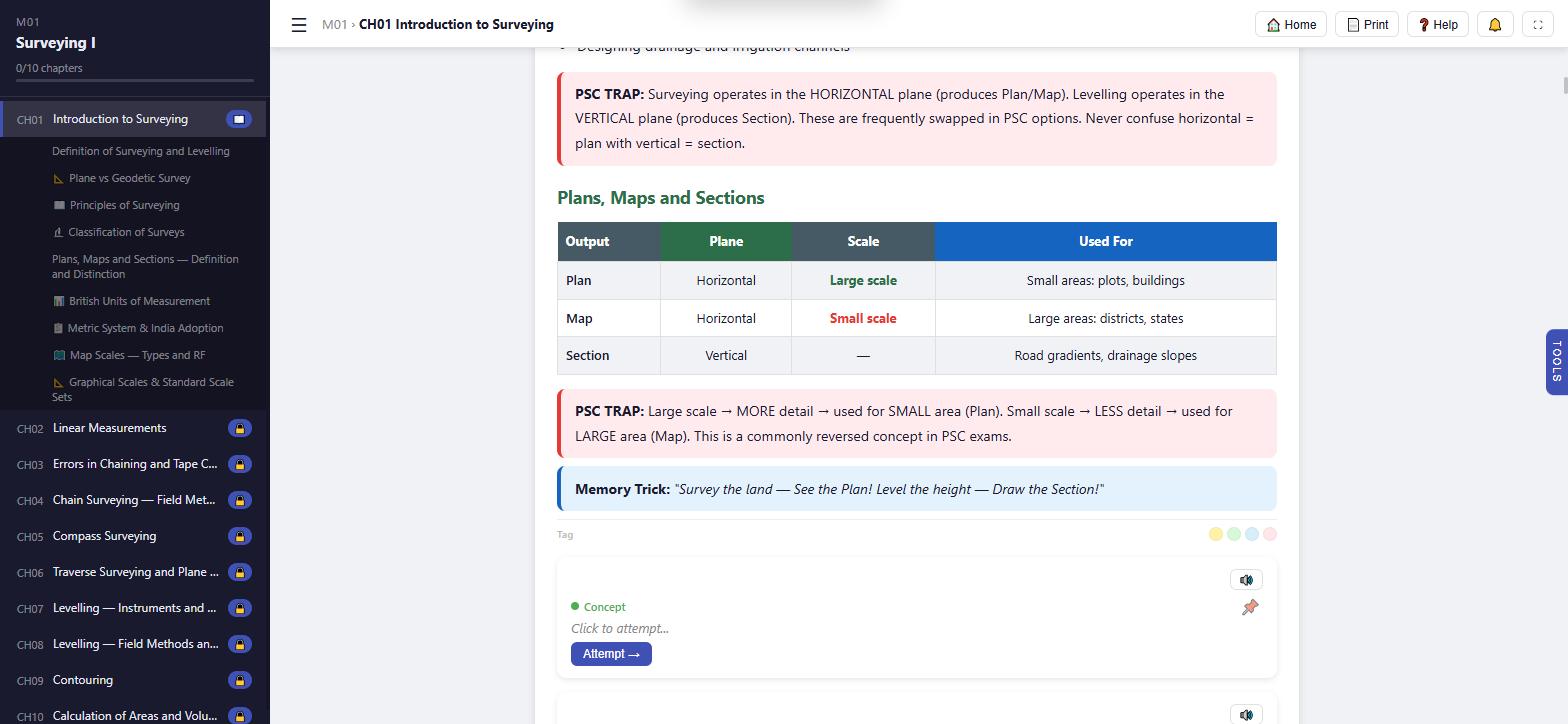
Almost every trap on these papers is built out of two things that are easy to tell apart when you see them separately, and easy to reverse when you are tired and the clock is running.
4. Feedback — and it has to be immediate
Getting a question wrong is genuinely useful, but only if you find out quickly, while you still remember your reasoning. A week later you have forgotten why you chose that option, and the correction has nothing to attach itself to.
This is the one that a self-study plan almost never solves, and it is the one thing software is unambiguously good at.
What to actually do with a wrong answer
Since feedback is the one that matters most and the one people waste, here is the specific thing to do with it. Every wrong answer is one of four kinds, and they need four different responses.
| Why it went wrong | How you can tell | What to do about it |
|---|---|---|
| Careless | You knew it the instant you saw the correct answer | Nothing to study. Note the pattern instead — rushing, wrong units, read the wrong row. Fix the habit, not the topic. |
| Half-known | You narrowed it to two and picked the wrong one | The profitable one. Go back to the two ideas you could not separate and study them together — not the whole chapter again. |
| Never knew it | The correct answer meant nothing to you | A real gap. Put the topic back in the queue. Do not panic-read the entire chapter around it. |
| Misread the question | Your answer was right for a question nobody asked | Slow down on the stem and mark what is actually being asked. Common in assertion-reason and statement questions. |
Most students treat all four the same way — re-read the chapter. Only one of the four is a chapter problem.
The second row is where marks are won, and it is the row people skip, because narrowing it down to two feels like almost knowing it. It is not almost knowing it. It is the exact place the examiner is aiming, and it is cheap to fix once you stop re-reading the whole topic and start comparing the two things you confused.
What this means for how you use any course, including ours
If the four things above are right, then some very common study habits are simply the wrong shape:
- Do not re-watch a video you understood. Re-watching is recognition. Close it and answer questions on it instead.
- Do not finish a subject and move on. Come back to it after you have half-forgotten it — that is where the value is.
- Do not practise one chapter at a time forever. Once you know a chapter, mix its questions in with its neighbours.
- Never leave a wrong answer unread. The explanation on a question you got wrong is worth more than five questions you got right.
None of that requires our platform. You can do all four with a textbook, a question bank and real discipline. What a system does is make them the default instead of a daily decision — which matters, because the uncomfortable option is never the one anybody picks at ten at night.
The uncomfortable implication
ഓർത്തെടുക്കുമ്പോഴാണ് പഠനം ഉറയ്ക്കുന്നത്.
Here is the part students dislike, and it is the most useful sentence in this article: the study session that felt good was probably the ineffective one.
Smooth, pleasant, everything-made-sense revision is recognition. Effortful, slightly frustrating, kept-getting-things-wrong practice is the one that moved your marks. Once you know that, you stop trusting the feeling and start trusting the score.
Which is really an argument about measurement — and that is the subject of a class is not a course, if you have not read it.
▶Free classes on the CivilEzy channelPick any topic you think you already know, and test yourself after.